 |
  |
|
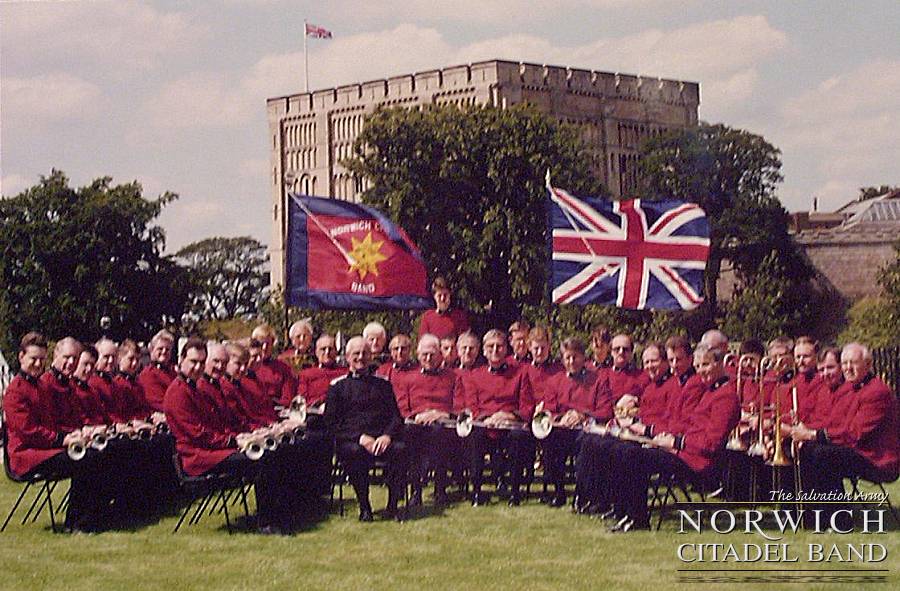
1882 was a prolific year for The Salvation Army. Its work commenced in Canada, India, Switzerland and Sweden as well as the opening of corps number 304 in Norwich, England. Some of the bandsmen of today can trace family roots back to those early days and are justly proud of their heritage. Today the band is very much involved in the life of the city and provides music for many civic, church and cultural events including the annual Lord Mayor's Civic Service and the Remembrance Sunday Parade. It also regularly plays in the magnificent 11th century Cathedral and in concert halls around the region. Travel to other parts of Great Britain giving concerts and leading worship at Salvation Army centres is part of the band's raison d'etre. Appearances at famous venues include London's Royal Albert Hall, Royal Festival Hall and Queen Elizabeth Hall, Amsterdam's Concertgebouw, the concert hall of the University of Cape Town, the Centennial Memorial Temple in New York City and Sandringham, the Queen's residence in Norfolk. For many years the band has toured overseas and has visited the Netherlands (1959 and 2012), Sweden (1971 and 2004), Norway (1990), the USA (1985, 1998 and 2010), Canada (1985 and 2010) and South Africa (1993), where NCB were the first Salvation Army band ever to visit the African continent from overseas and the first ever brass band to travel to that country.
Today Norwich Citadel remains a vital part of worship and witness in the heart of the city. It occupies the same site on St Giles Street as it has done since 1892, when a purpose-built suite of buildings was erected just 10 years after the corps opened. It was built in front of the old skating rink which still stands today. Over the years the buildings have been extended and improved to include facilities for worship and community service applicable to the needs of the 21st century. The band along with the Songsters (choir) and junior musicians are an integral part of a thriving corps with a membership of over 350. Catherines coffee shop and restaurant is also located in the same complex. Nearby, the Corps runs a Community Store (charity shop or thrift store) and the ARC (Advice and Rehabilitation Centre) for the disadvantaged. The Norwich Citadel Corps is truly a branch of the Christian church that reaches out with "Heart to God and Hand to man." If you are in the vicinity you are warmly invited to come and worship with us. Our services held in the Citadel in St Giles Street are at 10:30am and 4:30pm every Sunday with 'Church on the street' held in the Market Place most Sundays at 12:00.
The Castle with its imposing stone keep was built on a mound in the centre of the city around 1100. To this can be added thirty-two pre-Reformation churches around the city, built of local flint. The first clear picture of early Norwich is derived from King William's Domesday Book of 1065 when the population was 5500. There is an abundance of historic buildings within the remains of the ancient city walls, such as the Guildhall (1407), Pull's Ferry (circa 1450), the Old Meeting House (1693) The Assembly House (1754) and the Octagon Chapel (1756). Tudor, Elizabethan, Georgian and Regency architecture as well as Dutch gabled houses abound in Norwich. The market place has been in existence for over 900 years with its brightly coloured awnings spread before City Hall built in 1938 in the art-deco style. Situated 115 miles north-east of London, Norwich today is a busy commercial and shopping centre with the University of East Anglia (UEA), an international airport, the Castle Mall underground shopping centre, Chapelfield shopping mall and the Millennium Forum and library building situated close by City Hall. The Salvation Army Citadel complex is located immediately behind City Hall, from where it carries out so many facets of it's ministry of Christian care and concern for the community. Norfolk is a popular tourist destination. With its dry and sunny climate, East Anglia is one of the country's largest agricultural regions. The Norfolk Broads - a chain of inland waterways and lakes are a haven for wildlife and boating. You can sail right into Norwich too! The coast has miles of sandy beaches stretching from around the Norfolk peninsula from west to north to east. Her Majesty the Queen is a frequent visitor to Royal Norfolk and spends the Christmas and New Year holidays at Sandringham House, one of the royal residences. Diana, Princess of Wales was born in Norfolk as was Admiral Lord Nelson, who was educated at the Cathedral School.
| |||
|
[ Home | NCB History | Our Bandmaster | Recordings | Meet the Band | Other Links | Image Gallery | Guest Book | Contact the NCB ] | ||||





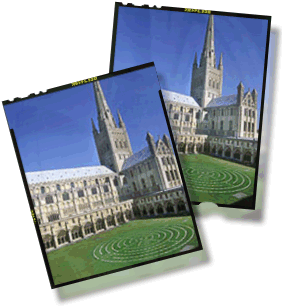 Norwich is a beautiful and ancient cathedral city, known
as 'A Fine City'. It is also the capital of the region of East
Anglia. Dominating the skyline are the Cathedral and Castle, two
great masterpieces of Norman architecture which provided twin
symbols of religious and military supremacy in the medieval city.
The cathedral with its 315' high spire (second tallest in Britain)
is built of cream-white stone from Caen in Normandy, France. Work
commenced on building this magnificent cathedral in 1096.
Norwich is a beautiful and ancient cathedral city, known
as 'A Fine City'. It is also the capital of the region of East
Anglia. Dominating the skyline are the Cathedral and Castle, two
great masterpieces of Norman architecture which provided twin
symbols of religious and military supremacy in the medieval city.
The cathedral with its 315' high spire (second tallest in Britain)
is built of cream-white stone from Caen in Normandy, France. Work
commenced on building this magnificent cathedral in 1096.